

In light of this year’s fire accidents…
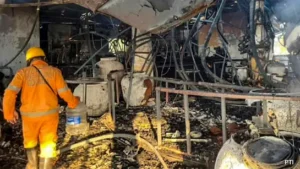
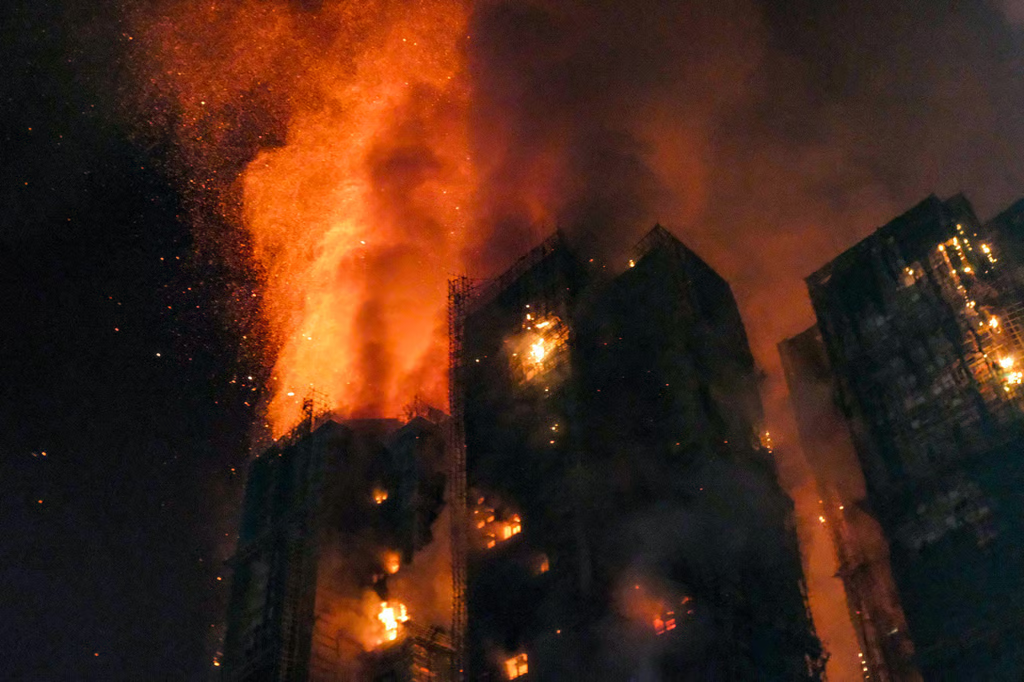
From the Kurnool bus fire accident where smoke spread faster than passengers could respond, to the Hong Kong building fire that choked entire floors within minutes, and India’s own Goa nightclub tragedy, along with fire outbreaks at the Kala Academy makeshift structure and the COP30 Pavilion, one truth is evident:
Active fire systems fail. Fires start anytime. And India still lacks proper technical guidance on material selection and fire-resistant construction practices.
Understanding Active Fire Safety Measures
Active fire safety includes hydrants, sprinklers, alarms, detectors, suppression systems, and extinguishers. They detect a fire, activate a suppression response, alert occupants, and assist evacuation. But these systems depend on perfect conditions: activation, maintenance, training, power, and zero human error.
Where Active Systems Fail
Active fire protection fails due to activation delays, electrical shutdowns, maintenance gaps, blocked equipment, human panic, disabled systems, and no structural protection. These aren’t hypothetical—they occurred in real 2025 fires.
Scenario 1 — Detection Delay
An electrical circuit overheats behind a wall panel. The initial smoke is light and below the detection threshold, so smoke alarms do not trigger.
Because the heat has not yet reached the sprinkler bulb’s activation temperature, sprinklers stay inactive.
As the circuit fails, power trips, shutting down ventilation. With no air movement, smoke now begins accumulating rapidly within the space. The fire grows into open flame, but the sprinkler network—unmaintained and partially clogged—fails to discharge.
Without early suppression, smoke density increases to the point where exit signage becomes invisible, and occupants lose orientation.
By the time responders arrive, visibility is near zero, evacuation routes are compromised, and most casualties occur due to toxic smoke inhalation and disorientation, not flame contact.
Active systems never activate.
Scenario 2 — Maintenance Failure
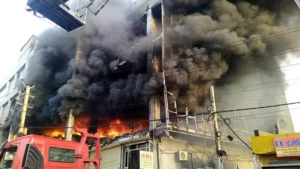
A fire starts in storage. Extinguisher is expired or pressure is low. Pumps are not reachable. Fire spreads to ducts and cable trays going through floors and walls resulting in loss of properly and maybe lives.
Equipment is present but useless.
Scenario 3 — Human Error
Fire starts in an unattended hotel room , alarm sensitivity reduced due to false alerts door of the room remains locked the one sprinkler present in the room is not enough to stop the fire as the direction of fire and sprinkler is different A small fire escalates through ceiling voids creating panic and compromising safety.
Human decisions disable safety.
Introducing Passive Fire Protection
Passive fire protection works without activation, electricity, or human intervention. It restricts fire spread, limits smoke migration, and maintains structural stability. Ameetuff’s coatings are the first barrier, supported by firestop mortars, fire-rated doors, compartment walls, and insulation boards.
Advantages of Passive Fire Protection
- Zero activation needed – they just start working when in contact with flame.
- Controls fire & smoke -coatings have smoke suppression properties.
- Prevents structural collapse- 2–4 hour certified coatings keep steel from weakening within minutes giving responders crucial time to stop the fire.
- Works during power failure – has no connection to electricity or water to work
- Enhances compartmentation.
- Reduces spread through concealed spaces (false ceilings, shafts, service voids)
- Increases evacuation time.
- Minimal maintenance.
- Achieves certified fire rating.
- Works on multiple substrates.
Conclusion
The fires we witnessed this year prove a single, undeniable truth: no building is safe with only active fire systems. Every airport, refinery, metro corridor, data center, tunnel, and critical government installation that India trusts today — from the New Parliament Building to Supreme Court works, AAI airports, Metro Rail projects, DLF/Embassy Grade-A complexes, Bhatinda & Panipat refineries, Konkan & IRCON tunnels, and global tech campuses like Microsoft, Apple, Amazon, and Tata Projects — all operate with both active and passive fire protection in place. That is why they stand, and why millions depend on them.
So the question is simple:
If the most important infrastructures are protected by passive fire systems, why shouldn’t you?
Ameetuff has spent over 35 years engineering and delivering advanced passive fire protection — from silicon-epoxy structural steel coatings, to duct systems, cable fire protection, fire-stop barriers, and interior fire-retardant solutions — tested as per BS 476, ASTM E119, ISO 834, UL-94, and approved by CPWD, MES, AAI, Metro Rail, Refineries, Defence, PSUs, and top private developers.
Passive fire protection isn’t just a recommendation anymore , it’s the benchmark of every project that takes life-safety seriously. Ameetuff continues to lead this transformation with Indian-made, globally-tested fire-resistant systems designed for real conditions, real failures, and real fires.
Because when active systems fail —
Ameetuff’s passive protection stands between survival and catastrophe.
Disclaimer
Passive systems must be applied as per manufacturer guidelines, approved thickness charts, substrate preparation, and relevant testing standards (BS 476, ASTM E119, ISO 834).