


This Flyer is issued in reference to the recent Kolkata warehouse fire to highlight how lack of passive fire protection in industrial buildings leads to rapid fire spread, early structural failure, and fatal smoke movement. Ameetuff Technical Paints Industries, with over 35+ years of specialization in passive fire protection systems for structural steel, HVAC ducts, service penetrations and partitions, provides solutions tested as per BS 476 (Part 20, 21 & 24), ASTM E119 / UL 263 and ISO 834 through NABL-accredited, ILAC-MRA recognized laboratories, and based on this technical and site experience, the following observations and prevention measures are presented.
WHAT HAPPENED AND WHY IT ESCALATED
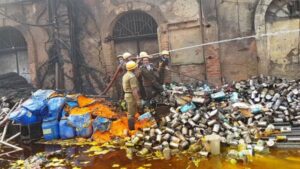
The fire broke out at night in an operational warehouse handling high fire-load materials (packaging, thermocol, plastics) with workers inside. The building had no valid fire clearance and no basic fire safety planning—no compartments, protected exits, or fire-resistant structure—leading to rapid fire spread, trapped occupants, fatalities, total loss, and restricted firefighting access.
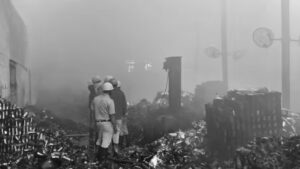
Key technical takeaways:
- High fire load without compartmentation led to full-building involvement within minutes
- No fire-rated exits or smoke control for safe evacuation lead to trapped workers.
- Unprotected structure accelerated collapse and blocked escape paths
- Absence of fire clearance reflects complete non-compliance with basic fire engineering norms
Based on the observed fire spread, smoke movement and early loss of structural stability, the following passive fire protection measures are directly relevant to this incident and could have significantly improved evacuation and rescue conditions:
- Fire-resistant coating on structural steel could have delayed temperature rise in columns and roof members, preventing early structural deformation and roof collapse that blocked escape routes and hindered rescue operations
- Fire-retardant coating on internal walls and partitions could have slowed flame spread from storage zones to work and resting areas, limiting full-building involvement within minutes
- Fire-stop barrier systems and fire-stop boards at cable and duct openings could have prevented fire and smoke from travelling rapidly through service penetrations into adjacent spaces
- Fire-resistant coating and sealing on HVAC ducts could have stopped ducts from acting as channels for smoke and flame spread across the warehouse
- Fire-retardant coating on electrical cables could have reduced flame propagation and secondary short-circuits, limiting fire escalation through electrical networks
- Fire-retardant coating on wooden doors and exit elements could have delayed ignition and maintained exit usability, providing occupants and rescuers additional time for evacuation
PASSIVE FIRE PROTECTION IN FACTORIES — APPLICATION-WISE CONTROL
- Fire Resistant Structural Steel Coating / Fibre Intumescent Mortar / Vermiculite Coating
Applied on columns, beams, trusses and mezzanines to prevent early strength loss and roof collapse, keeping evacuation routes and fire access structurally stable during fire. - Fire Resistant Coating for G.I. Ducts + Ameetuff Fire Resistant Sealants
Applied on HVAC ducts and joints to prevent ducts from transmitting fire and smoke into control rooms, offices and worker rest areas through ventilation systems. - Fire Stop Barrier System + Fire Stop Boards + Fire Resistant Sealants
Used at wall and floor penetrations for cables, ducts and pipelines to block fire and smoke spread between compartments and across production zones. - Fire Retardant Cable Coating + Ameetuff Insulating Varnish
Applied on power and control cables to limit flame spread, reduce dripping and restrict cascading short circuits that often escalate small electrical faults into full fires. - Fire Resistant Coating for Gypsum Board & Wall
Applied on internal partitions and shaft walls to delay fire transfer between storage, production and utility areas, improving compartment integrity. - Fire Retardant Coating for Wood / Bamboo
Applied on doors, frames and wooden partitions to delay ignition, helping exits remain usable for longer during evacuation and rescue operations. - Fire Retardant Coating for Fabrics, Paper & Corrugated Boxes
Used in packing, storage and dispatch areas to reduce rapid flame spread through textiles and packaging materials, limiting flash fire development. - Fire Retardant Vapour Barrier + Vapour Barrier Sealant ALB-94
Applied on insulation systems and joints to prevent moisture ingress and corrosion under insulation while also reducing fire propagation through insulated services. - Anti-Corrosive Heat Resistant Silicon Epoxy Paint + Chemical/Acid Fume Resistant Coatings
Used in process areas to protect steel and equipment from corrosion and heat exposure, preventing structural weakening that can worsen fire damage. - Fireproof Paints / ARC-251R for General Steel and Equipment
Applied on machinery frames, racks and support structures to reduce flame spread and surface ignition in equipment-dense zones. - Fire Retardant Coating for Plastic / PVC
Applied on cable trays, pipelines and plastic housings to reduce dripping and flame travel along polymer components. - Fire Retardant Clear Coating for Events and Temporary Installations
Used on temporary partitions, fabric structures and stage setups inside factory premises to reduce ignition risk during shutdowns and maintenance activities.

WHY AMEETUFF
Ameetuff provides passive fire protection systems tested as per BS 476 (Part 20, 21 & 24), ASTM E119 / UL 263 and ISO 834 at NABL-accredited laboratories with ILAC-MRA recognition, which means the test reports are valid for acceptance both in India and internationally under mutual recognition arrangements. Our systems are implemented across critical infrastructure including the New Parliament Building (Central Vista), Delhi & Guwahati Airports, multiple Metro corridors, major data centers (Microsoft, Amazon, Flipkart), and large industrial and refinery projects, where performance is evaluated through consultant approvals, third-party inspections and statutory audits. Ameetuff focuses on structural stability, compartment integrity and smoke control — the parameters that determine real fire survivability, not just certificate compliance.
ACCOUNTABILITY & WAKE-UP CALL
If the warehouse had no valid fire safety certificate, the bigger failure is why it was allowed to operate at all. Fire approvals are meant to prevent disasters, not explain them after lives are lost. Stronger inspections, real penalties and zero tolerance for non-compliance are essential if industrial fire safety in India is to improve.
